
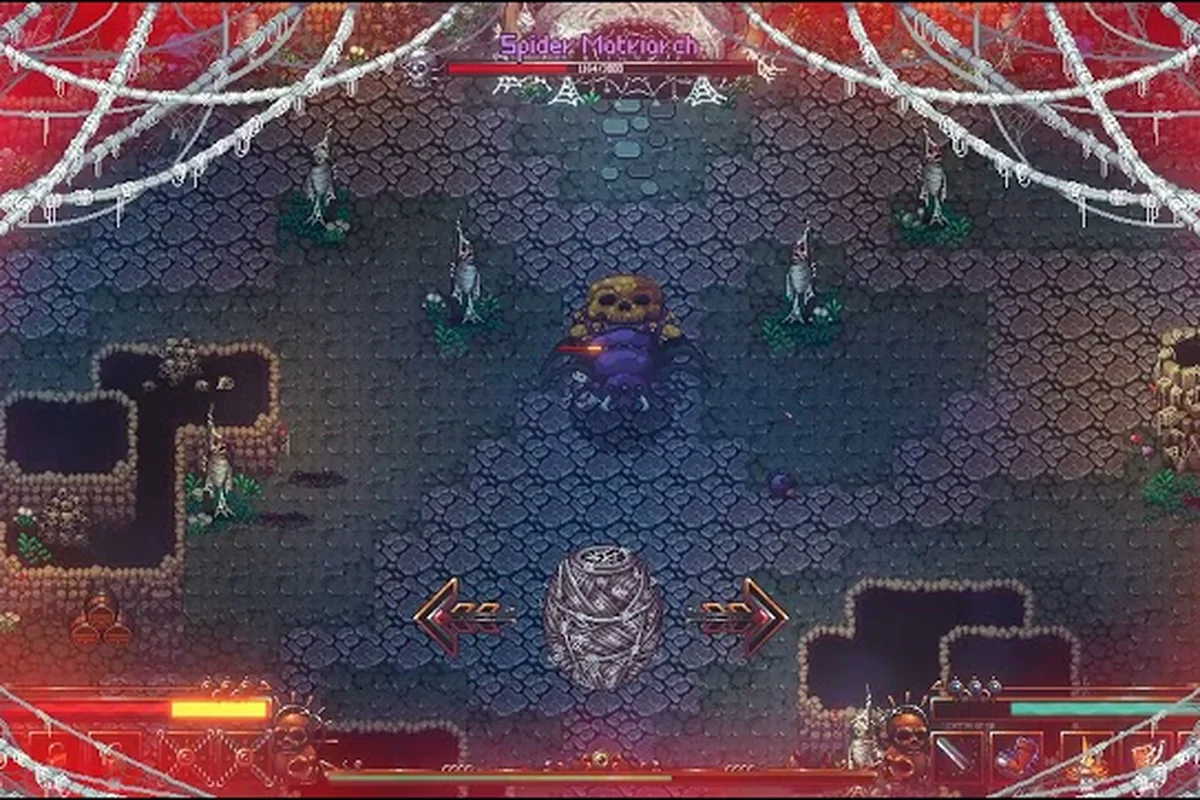
The Emberville weapon guide you start with is intentionally bare-bones: you wake up in the Vitromotus with no memories, two attack buttons, and a single rusty blade. Because the game binds its entire combo system to the weapon you equip — rather than to your character class — your choice of armament shapes how every fight in this dungeon-crawling action RPG actually feels. The Steam discussions board confirms the two-button combat layered with weapon-bound combos, and Cygnus Cross has built the whole loot chase around making that weapon swap meaningful. Picking the right blade early is the difference between breezing through the Sunken Chapel and getting shredded by the first mini-boss.
Emberville Weapon Categories and Core Differences
Weapons in Emberville are sorted into distinct categories that each carry their own swing arc, stamina cost, and combo potential. The current Early Access build, which launched October 27 according to the official Emberville publisher announcement on Terminals, ships with five primary categories, and each one teaches a different way to read enemy telegraphs. The full Emberville weapon list is still growing with patches, but the category framework is already locked in, so understanding these buckets is the fastest way to plan a build.
Each of the five Emberville weapon categories — Swords, Axes, Spears, Daggers, and Hammers — defines a complete combat identity rather than just a stat bundle, dictating swing arc, stamina cost, and combo routes that all downstream Emberville weapon combos branch from, which is why new players should pick a category and stick with it for at least the first three hunts before judging viability.
-
Swords — Balanced speed and range, the default training wheels
-
Axes — Slow, high stagger, devastating single hits
-
Spears — Longest reach, lower per-hit damage, excellent spacing tool; the Emberville spear guide breaks down its full moveset
-
Daggers — Fastest swing speed, combo extensions, glass-cannon feel
-
Hammers — Slowest swing, area-of-effect arcs, crowd control specialists
Each category has its own Emberville weapon combos tree, which means the Emberville best weapon for you depends not just on raw stats but on which combo branches you intend to unlock. The Emberville weapon bound combos breakdown goes deeper into that progression system, but at the category level the trade-offs are already obvious.
| Category | Swing Speed | Damage Tier | Best Enemy Type | Stamina Cost |
|---|---|---|---|---|
| Swords | Medium | Medium | Versatile | Low |
| Axes | Slow | High | Armored | High |
| Spears | Medium | Medium-Low | Ranged / Spaced | Medium |
| Daggers | Fast | Low | Light / Groups | Very Low |
| Hammers | Very Slow | Very High | Clusters | Very High |
Notice how the Emberville weapon categories form a clean rock-paper-scissors triangle: daggers shred light fodder, axes crush armored bruisers, and spears punish the enemies that chase daggers. The Emberville weapon types aren't pure stat sticks — each one implicitly tells you which encounters it was designed for, and ignoring that matchup is the fastest way to burn through healing flasks.
How Weapon-Bound Combos Actually Work
Emberville's combat sticks to two buttons — a light attack and a heavy attack — but the third layer of depth comes from the weapon itself. As the latest Emberville gameplay reveal on Terminals puts it, the game uses a "weapon-bound combo system" where each weapon category unlocks its own branching combo strings. Chain a light-light-heavy sequence with a sword and you get a horizontal slash finisher; do the same input with an axe and you get a cleave that knocks the target back two meters.
The combo inputs follow a consistent three-tier rhythm that scales with your stored Combo Meter segments: each L-L opener adds one segment, the L-L-H mid-string spends two to apply an elemental effect on tier-3 weapons, and the L-L-H-H finisher dumps every stored segment into a single heavy burst — so a dagger's three-segment backstab teleport can only fire if you land both prior inputs cleanly, while a sword's rising thrust finisher is more forgiving because every weapon category shares that same L-L-H-H commit cost.
-
Tier 1 (Input String: L-L) — Short opener, builds Combo Meter by 1 segment
-
Tier 2 (Input String: L-L-H) — Mid-string payoff, consumes 2 segments, adds an elemental effect on tier-3 weapons
-
Tier 3 (Input String: L-L-H-H) — Full finisher, spends all stored segments for a heavy burst
Players report that the Emberville weapon combos are tied to the weapon type itself, not to the class, which means swapping from a sword to a dagger mid-fight changes your available moveset without needing to re-equip skills. Because the Emberville class system layers inherited skills on top of weapon combos, two players running the same weapon can have very different combo trees. The skill tree from your class adds modifiers — a Vanguard might buff finisher damage, while a Ranger class adds projectile properties to your tier-2 strike.
| Combo Tier | Sword Effect | Axe Effect | Dagger Effect |
|---|---|---|---|
| L-L (1 segment) | Quick slash | Overhead chop | Stab + step back |
| L-L-H (2 segments) | Horizontal sweep | Knockback cleave | Rapid slash flurry |
| L-L-H-H (3 segments) | Rising thrust finisher | Ground slam shockwave | Backstab teleport finisher |
The Emberville best weapon for combo enthusiasts is overwhelmingly the dagger, because the three-segment finisher repositions you behind the enemy for an instant backstab bonus. Swords are the most forgiving, while axes reward players who can manage their stamina bar across a long Tier-3 commitment. The Emberville weapon combos are also where the "best weapon" debate gets subjective — your class build, not just the weapon, decides which combo branch is worth specializing in.
Emberville Weapon Stats and What Actually Matters
Rather than reading each weapon's tooltip in isolation, the most efficient way to evaluate Emberville weapon categories at the early-game tier (levels 1-10) is to compare them side-by-side on the five stats that actually drive combat outcomes: base damage, swing speed, stamina per swing, primary scaling, and secondary scaling. The table below isolates exactly those values so you can spot which trade-offs matter for your build instead of guessing from flavor text.
| Stat | Sword | Axe | Spear | Dagger | Hammer |
|---|---|---|---|---|---|
| Base Damage | 18-24 | 28-36 | 14-20 | 12-16 | 32-40 |
| Swing Speed (ms) | 380 | 520 | 420 | 280 | 640 |
| Stamina per Swing | 6 | 11 | 7 | 4 | 14 |
| Primary Scaling | Strength | Strength | Dexterity | Dexterity | Strength |
| Secondary Scaling | Dexterity | — | Strength | — | — |
Two patterns jump out. First, swords and spears are the only categories with dual scaling, which makes them the safest weapons to commit to across a long playthrough because they don't punish you for spreading your stat points. Second, hammers have the highest damage ceiling but the worst stamina economy — a full hammer combo chain costs more stamina than a sword's entire three-tier finisher plus one extra opener.
The Emberville best weapon question rarely has a single answer because the developers designed the categories to be situationally optimal. According to community testing, the strongest opener for most early-game builds is a sword because of its low stamina cost and dual scaling, but the strongest single-target nuker is a hammer, and the strongest kiting tool is a spear. The Emberville weapon types cover enough ground that you should treat your weapon slot as a loadout slot — swap based on the encounter, not the area.
Choosing the Best Weapon for Your Build
Because Emberville uses the inherited skill leveling system described in the Cygnus Cross gameplay preview, your "active class" can change between expeditions while your learned skills stay. That means the Emberville best weapon is really a function of which class you intend to bring into the Vitromotus for a given run, not which class you've been grinding. Players who bounce between classes benefit most from swords and spears (dual scaling), while specialists who commit to one class can exploit a category's unique scaling.
Here is a practical decision tree for picking the Emberville best weapon in your current slot, mapped against the four core weapon categories (sword, axe, spear, dagger, hammer) and the five common activity archetypes you will cycle through between expeditions: leveling, mini-boss farming, ranged kiting, backstab crit chains, and AoE room clears. Walk through each branch by asking which of those five contexts your Vitromotus run actually demands, and the category choice will usually fall out without needing to respec your inherited Cygnus skill tree at all.
-
If you are level 1-10 and learning the combat rhythm: Equip a sword. Low stamina cost, dual scaling, and forgiving combo windows let you learn the Emberville weapon combos without burning through healing items.
-
If you are farming armored mini-bosses: Equip an axe. The knockback cleave staggers most shielded enemies, and the Tier-3 ground slam breaks guard stances that other weapons cannot.
-
If you are kiting ranged enemies in the Vitromotus corridors: Equip a spear. The reach advantage lets you hit enemies before they enter their projectile windup, and the dexterity scaling keeps your swing speed competitive.
-
If you are running a backstab-centric crit build: Equip a dagger. The Tier-3 backstab teleport finisher can hit 2.5x damage on staggered enemies, and the very low stamina cost lets you chain finishers back-to-back.
-
If you are clearing crowded rooms for loot or villager rescue missions: Equip a hammer. The area-of-effect arcs pull multiple enemies into one swing, and crowd control keeps your healer companion alive during long fights.
The Emberville weapon categories aren't rigid class roles, but they do reward a playstyle. The Emberville legendary weapons hunt is where this matters most, because farming a specific legendary will only feel rewarding if you already understand which category fits your muscle memory. A legendary axe in a hammer player's inventory is wasted potential.
Weapon Upgrades, Farming, and Layered Progression
The Emberville weapon list grows through three layered systems: crafting at the estate blacksmith, drops from dungeon enemies, and rare boss weapons that require specific class levels. According to community data, the estate's crafting station can upgrade a common weapon to a +5 tier using ore and monster parts, but the underlying weapon category never changes — a +5 sword is still a sword, just with bigger numbers. This is where the Emberville armor and loot systems tie together, because weapon upgrades share the same material economy as armor upgrades.
The practical Emberville weapon farming path looks like this: focus your early play sessions on the Vitromutus hallway runs (rooms 4 through 9 are the most reliable common-drop source) so your stash has at least one of each of the five Emberville weapon categories — sword, axe, spear, bow, and catalyst — before you invest a single ore into upgrades, since the blacksmith's +5 cap is shared per category and respec costs scale harshly after category commit.
-
Farm common drops in early Vitromotus rooms until you have at least one weapon in each of the five categories.
-
Identify your preferred category by clearing one full dungeon with each weapon type and noting which one felt the most natural to your inputs.
-
Commit your upgrade materials to that category — a +3 sword outperforms a +0 axe for most players, so spreading resources across categories is a trap.
-
Unlock the Tier-3 combo finisher for your chosen category by leveling any class to 15, which is when the developer enables the full combo tree.
-
Hunt the category-specific legendary that drops from the relevant mini-boss. Community reports suggest each category has at least one named legendary available before level 25.
The Emberville weapon guide progression curve rewards specialization, but the inherited class skills mean you can always pivot later. Because the Emberville class system lets you inherit skills across class changes, the weapon choice that locks in your combo tree doesn't lock in your entire build.
Emberville Weapon Combos, Synergies, and Class Pairings
The Emberville weapon combos reach their full potential when paired with the right inherited class skills. The two-button combat system is deceptively simple, but the synergy layer between weapon category and active class is where veteran players spend their optimization time. For example, a sword's Tier-3 rising thrust finisher launches smaller enemies into the air — pair that with a class that has an aerial damage modifier and the finisher's effective damage triples. A spear's reach advantage pairs naturally with classes that have mid-range projectile skills, letting you stay outside the enemy attack range while still applying pressure.
The table below distills community testing from the current Emberville Early Access build into the strongest class-and-weapon pairings, with the synergy column pointing to the specific combo node or passive that drives the damage spike — for instance, the Sword + Vanguard pairing works because the Tier-3 rising thrust finisher chains directly into the Vanguard's shield bash, while Hammer + Guardian leverages the AoE slam's party-wide damage reduction passive to make the Guardian's low-mobility kit survivable in group content.
| Weapon | Strongest Class Pairing | Combo Synergy |
|---|---|---|
| Sword | Vanguard | Rising thrust + shield bash follow-up |
| Axe | Berserker | Ground slam + rage stack multiplier |
| Spear | Ranger | Tier-2 sweep + poison arrow volley |
| Dagger | Rogue | Backstab finisher + crit damage passive |
| Hammer | Guardian | AoE slam + party-wide damage reduction |
Because the Emberville weapon categories each lean into a different stat and a different combo style, the "best weapon" really does shift based on your class leveling priority. The Emberville weapon combos are most powerful when the combo tree and the class skill tree compound each other rather than overlapping. A Berserker running a hammer will see their ground slam hit twice as hard but still pay the full stamina cost; a Berserker running a dagger gets crit modifiers but loses the AoE coverage that made Berserker strong in the first place.
If you're trying to decide where to invest your next few hours, the cleanest answer is to commit to one category, level one class into it, and only after the Tier-3 finisher feels automatic should you experiment with a second category. The Emberville weapon guide progression punishes indecision more than it punishes a "wrong" choice, because the two-button system and weapon-bound combos mean any category you master will still work in most encounters.
Frequently Asked Questions
What is the best weapon for beginners in Emberville?
The sword is the best starter weapon because it has the lowest stamina cost per swing and dual scaling in both Strength and Dexterity, which means early stat point allocation does not lock you into a single build. Its Tier-2 horizontal sweep also gives new players a forgiving combo finisher that staggers most early-game enemies without requiring precise spacing.
How many weapon categories are in Emberville?
Emberville currently ships with five weapon categories — sword, axe, spear, dagger, and hammer — each with its own combo tree, swing speed, and scaling stat. The developers at Cygnus Cross have hinted at additional categories in post-Early Access patches, but the five existing ones cover every major playstyle niche from glass-cannon crit builds to tanky AoE clear.
Do weapon combos depend on the class you have equipped?
Combos themselves are bound to the weapon, but the class layers inherited skills on top of the combo effects. This means the input string L-L-H-H always produces the same finisher for a given weapon, while your active class modifies the damage type, range, or added effects. Swapping your class does not change your available combo inputs.
Where do you find legendary weapons in Emberville?
Legendary weapons drop from category-specific mini-bosses scattered through the Vitromotus, and each mini-boss is tied to one of the five weapon types. Community testing suggests you need to be at least level 15 in a relevant class to trigger the legendary drop, and farming rare materials at the estate's crafting station is required to upgrade a legendary past its base tier.
Can you respec weapon scaling in Emberville?
You cannot individually respec a weapon's scaling, but you can reforge a weapon's secondary stat at the estate's anvil using rare materials. The primary scaling stat is fixed per category, so the only way to change your weapon's main stat is to switch to a different category entirely. Reforging does not cost class levels and can be done at any time after unlocking the anvil.