
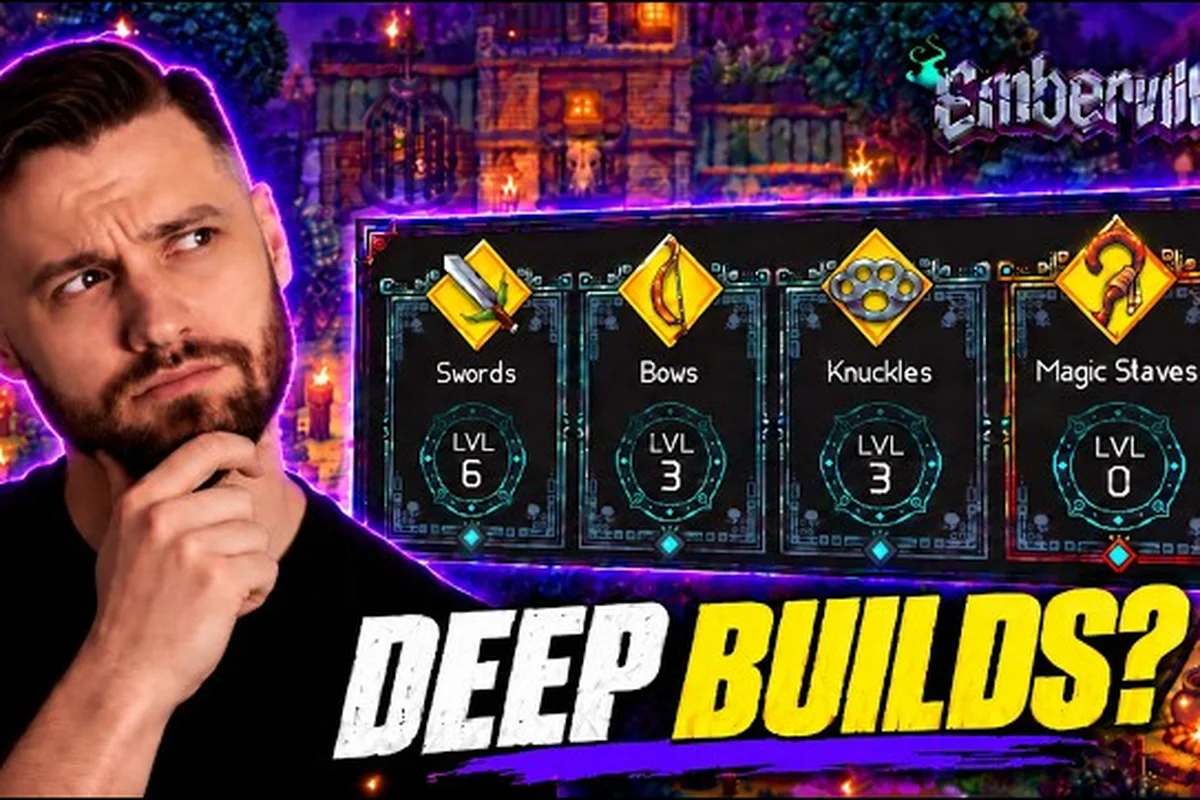
Picking the right loadout before you descend into the Vitromotus is the single biggest lever you have in Emberville. Because the two-button combat system binds combos to specific weapons, every stat point and class choice feeds directly into how your melee swings or ranged volleys actually perform, and a half-baked plan will get you erased in the first dungeon room you sleepwalk into. This Emberville build guide walks through the stat priorities, class combos, and Vitromotus-ready setups that separate a quick wipe from a profitable run, so you can spend your first hours actually rebuilding the estate instead of respawning in it.
How Emberville's Build System Actually Works
Before we slot specific weapons, it helps to understand the moving parts underneath every build. Emberville is a class-based action RPG where you inherit skills by leveling multiple classes and then designate an "active combat class" that determines your core moveset, while passive bonuses from your other leveled classes stay in the background. The weapon you hold further layers on weapon-bound combos, so a Warrior with a Greatsword plays nothing like a Warrior with dual Daggers, even though their skill page looks similar on paper.
The estate hub, your crafting stations, and the loot you pull out of the Vitromotus all plug into this system, which is why a structured Emberville build planner approach pays off so quickly. According to the official Steam page, the game ships with crafting, class progression, and a procedurally generated dungeon that pushes you to adapt on the fly, so a build is not a rigid script but a foundation you tweak every run.
Core Stats at a Glance
Every Emberville meta build in Early Access orbits around six primary stats, each tied to different damage sources and survivability tools. Understanding which stat scales which playstyle is the first step in any beginner-friendly Emberville build guide, because a stat dump that ignores weapon scaling is the most common way new players get stuck in Act 1.
| Stat | Primary Effect | Best For | Secondary Benefit |
|---|---|---|---|
| Strength | Melee physical damage | Greatsword, Axe, Mace users | Carry weight, stagger |
| Dexterity | Attack speed, ranged damage | Bow, Dual-wield, Dagger | Dodge distance, crit chance |
| Vitality | Max HP, bleed resistance | Tanky melee, frontline | Slow HP regen ticks |
| Focus | Skill damage, mana pool | Hybrid caster-melee | Cooldown reduction |
| Endurance | Stamina pool, block efficiency | Sustained combat | Equip load tolerance |
| Luck | Loot rarity, rare drop chance | Loot hunters | Minor crit on ranged |
When in doubt, dump early points into your weapon's primary stat (Strength for melee, Dexterity for ranged) and back it up with Vitality so the first boss does not one-shot you before you learn the dodge window. If you want a deeper walkthrough of how these stats interact with class passives, the passive skills overview lays out which class nodes feed which stat.
Class Inheritance and Active Loadouts
The inheritance system is what makes Emberville meta builds feel different from a standard class-locked RPG. You can level, say, a Knight for defensive passives and a Ranger for ranged bonuses, then designate either as your active combat class to dictate your combat kit. The class you actively fight as determines your skill bar, your heavy attack, and your weapon combo availability, while the other class quietly pumps passive bonuses into the background.
This means the "best build" is rarely a single class. It is a pair (sometimes a trio) chosen so that their passive nodes complement your chosen weapon, and so the active class's skill bar covers the gaps your weapon leaves open. For a deeper comparison of how Knight and Warrior passives stack for melee, the respec and gear tuning guide shows how to redistribute points once you start pulling rare drops.
Stat Priority and Early-Game Build Foundations
Your first 10 levels in the Vitromotus define the rest of your build, because respecs are limited and your early stat spreads tend to lock in your weapon archetype. The community-reported "Emberville best build for Early Access" patterns in the current beta branch all share a common backbone: front-load your weapon's main stat, sprinkle Vitality for survivability, and only branch into Focus or Luck once your weapon is comfortable to wield.
If you are still learning the ropes, the safest Emberville beginner build is a Vitality-heavy Strength weapon with a Knight as your active class and a Ranger or Rogue in the inheritance slot for passive crit and dodge bonuses. This combination forgives mistimed dodges, scales naturally as you find better Greatswords or Maces, and never feels wasted because every point still feeds a useful passive from the secondary class.
Stat Spread by Weapon Archetype
Different weapons want different stat spreads, and the right spread early is what separates a meta build from a struggling one. The table below distills the most common stat spreads community testers are running on the Early Access branch as of this guide's last update, and it works as a plug-and-play starting point for any Emberville build planner you sketch in your head.
| Weapon Archetype | STR | DEX | VIT | FOC | END | LCK | Active Class | Inheritance |
|---|---|---|---|---|---|---|---|---|
| Greatsword | 3 | 1 | 2 | 0 | 1 | 0 | Knight | Warrior |
| Dual Daggers | 1 | 3 | 1 | 0 | 1 | 1 | Rogue | Ranger |
| Bow | 1 | 3 | 1 | 0 | 1 | 2 | Ranger | Rogue |
| Crossbow | 2 | 2 | 2 | 0 | 1 | 0 | Ranger | Knight |
| Mace & Shield | 3 | 0 | 3 | 0 | 2 | 0 | Knight | Cleric |
| Spear | 2 | 2 | 2 | 0 | 1 | 0 | Warrior | Ranger |
The numbers above reflect point ratios per level, not absolute values, so think of them as a guideline for where to invest first. A player chasing a pure Emberville melee build should keep FOC and LCK at zero until they hit a damage wall, while a ranged-focused player can comfortably dump the rest of their points into LCK once DEX is maxed.
Common Build Mistakes to Dodge Early
Even with a solid stat spread, players new to the inheritance system often burn their first respec on a doomed hybrid because they spread points too thin. The Vitromotus rewards specialization, because the deeper floors pack enemies with damage resistances that punish a jack-of-all-trades stat page. If you are still learning the basics, the beginner progression walkthrough is a useful primer on what the first 10 hours of Emberville should look like.
Three pitfalls show up over and over in community reports. First, leveling Focus before you have unlocked a Focus-scaling skill, so the stat does nothing for two or three level-ups. Second, ignoring Endurance until a boss's combo drains your stamina bar mid-swing and leaves you standing still. Third, treating Luck as a mainstat when it really shines as a finishing touch once your damage is online, and spending early points there is the most common reason ranged players feel weak in the first dungeon.
Top Melee Builds for the Vitromotus
Melee is the most forgiving archetype in Emberville because you can stack Vitality and Endurance to absorb mistakes while still dishing out burst through weapon combos. The two-button combat system means every melee weapon has a light/heavy split that scales with different stats, so a build is really a statement about which combo path you want to specialize in.
Below are the three strongest melee loadouts community testers are running on the current Early Access branch, each tuned for a different style of Vitromotus run. These are not the only viable builds, but they are the most reliable templates for an Emberville best build search and they layer cleanly on top of the stat spread table above.
Greatsword Knight (Tank-Bruiser)
The Greatsword Knight is the textbook Emberville melee build for players who want to feel unkillable while still swinging the biggest weapon in the game. Strength feeds the slow, devastating heavies, Vitality keeps your HP pool comfortable, and Endurance lets you chain combos without running dry on stamina during a boss's windup animation.
| Slot | Choice | Reason |
|---|---|---|
| Active Class | Knight | Shield Bash + heavy Greatsword combo |
| Inheritance | Warrior | +15% heavy damage passive at lvl 10 |
| Weapon | Greatsword | Highest single-hit damage in game |
| Off-hand | Tower Shield | Stagger on block, emergency bash |
| Stat Priority | STR > VIT > END | Maximize burst and survivability |
| Best Drop | Ember-Forged Greatsword | +20% burn damage on heavy hit |
The playstyle is simple: open with a heavy, follow with two lights to chain the combo finisher, then Shield Bash any enemy that tries to punish your recovery. The Ember-Forged Greatsword is a community-reported chase drop from the Forgewright boss in Act 2, and it elevates this build from solid to top-tier for any meta build conversation.
Dual Dagger Rogue (Burst Assassin)
If you would rather delete enemies before they can swing, the Dual Dagger Rogue is the fastest melee build in the current patch. Dexterity scales both your attack speed and your crit chance, and the inheritance system lets you pull the Ranger's crit-on-ranged-hit passive and reroute it into a global crit node for melee, which is one of the most satisfying interactions in the game.
| Slot | Choice | Reason |
|---|---|---|
| Active Class | Rogue | Backstab bonus + dagger flurry |
| Inheritance | Ranger | +5% global crit at lvl 8 |
| Weapon | Dual Daggers | Fastest attack speed tier |
| Off-hand | None | Dual-wield bonus damage |
| Stat Priority | DEX > LCK > VIT | Crit stacking with survivability |
| Best Drop | Fang of the Hollow | +12% crit on targets above 70% HP |
This is the build to pick if you hate long fights. The rotation is light-light-heavy into a Backstab, then roll out before the enemy recovers, and your crit stacking means even trash mobs melt in two hits once you hit level 12. For a fuller breakdown of how crit and luck interact across classes, the respec and stat tuning guide has a useful chart on breakpoints.
Spear Warrior (Mid-Range Bruiser)
The Spear Warrior is the build for players who want melee damage with the safety net of a longer reach. Spears occupy a unique spot in Emberville's weapon table because they keep full melee damage scaling but extend the hitbox, so you can poke enemies between their attack windows without giving up the Strength scaling that makes Greatswords terrifying.
| Slot | Choice | Reason |
|---|---|---|
| Active Class | Warrior | +10% reach passive at lvl 6 |
| Inheritance | Ranger | Aim-stance for charged thrust |
| Weapon | Spear | Best reach-to-damage ratio |
| Off-hand | Javelin | Ranged option for pulls |
| Stat Priority | STR = DEX > VIT | Hybrid scaling for reach + damage |
| Best Drop | Vitromotus Lancet | Armor pierce on charged thrust |
The Spear Warrior is also the most beginner-friendly of the three melee builds because the reach window forgives the imprecise dodge timing that new players struggle with. If you want a smoother transition from a basic Strength start to a real build, the progression and leveling guide covers how to pace your first skill points so this build comes online by level 8.
Top Ranged Builds for the Vitromotus
Ranged builds in Emberville lean harder into positioning and crit stacking than melee does, because you give up the safety of a shield and the sustain of melee life leech. The trade-off is that no enemy in the Vitromotus can hurt you if you manage your line-of-sight correctly, and the right build turns you into a kite-bot that deletes champions before they cross the room.
The two-button combat system still applies, so your light attack is a quick arrow and your heavy is a charged shot that scales with Focus and your weapon's base damage. These three ranged builds are the most popular templates community testers are publishing right now, and they are good entry points for any player who wants a ranged-focused Emberville build planner starting point.
Bow Ranger (Crit Sniper)
The Bow Ranger is the cleanest ranged build in the game and the most common starting point for new ranged players. Dexterity drives both your attack speed and your crit chance, so a pure DEX stacking path with secondary LCK investment gives you the fastest clear speed of any ranged setup in the current patch.
| Slot | Choice | Reason |
|---|---|---|
| Active Class | Ranger | Headshot bonus + arrow volley |
| Inheritance | Rogue | +8% crit from stealth passive |
| Weapon | Longbow | Highest single-shot ranged damage |
| Quiver | Fire Arrows | Burn DoT for kiting elites |
| Stat Priority | DEX > LCK > VIT | Crit + dodges for survival |
| Best Drop | Whisperstring | -20% draw time, +10% crit |
The Bow Ranger's rotation is draw-aim-fire-roll, repeat, and you weave in a Headshot whenever an enemy stops moving. The Whisperstring bow is a level 15+ chase drop, but a crafted Longbow with crit gems will carry you through the entire Vitromotus if you do not want to grind for it.
Crossbow Knight (Tank Sniper)
If you want ranged damage without giving up melee survivability, the Crossbow Knight is the build that bridges both worlds. You sacrifice raw burst compared to a Bow Ranger, but you gain Shield Block while aiming, which means you can soak a hit, fire a heavy bolt, and roll out before the enemy closes the gap. It is also one of the more reliable Vitromotus-ready setups because the survivability does not collapse when you are caught out of position.
| Slot | Choice | Reason |
|---|---|---|
| Active Class | Knight | Shield Block + Bolts |
| Inheritance | Ranger | +10% ranged damage passive |
| Weapon | Heavy Crossbow | Best armor pierce ranged |
| Off-hand | Tower Shield | Block while aiming |
| Stat Priority | DEX = STR > VIT | Hybrid damage + HP pool |
| Best Drop | Stoneheart Bolter | Armor pierce + knockback |
The Crossbow Knight is also one of the few ranged builds that handles boss fights comfortably, because the Shield Block lets you ignore the boss's most dangerous attack windows while you line up charged shots. Community testers report this build clearing all current Early Access bosses with consistent timings.
Hybrid Caster-Ranger (Glass Cannon)
The most advanced ranged build in the current patch is the Hybrid Caster-Ranger, which splits Focus and Dexterity to make use of Emberville's skill inheritance system. By leveling a Cleric in the inheritance slot, you unlock healing and shield skills that turn your otherwise fragile ranged build into a self-sufficient glass cannon, and you keep enough Focus to use the Cleric's burst damage skills on cooldown.
| Slot | Choice | Reason |
|---|---|---|
| Active Class | Ranger | Bow kit + arrow types |
| Inheritance | Cleric | Heal + shield skills on cooldown |
| Weapon | Recurve Bow | Faster draw than Longbow |
| Off-hand | Tome | Focus scaling for cleric skills |
| Stat Priority | DEX > FOC > VIT | Damage + sustain |
| Best Drop | Twinweave Recurve | +Focus scaling on every hit |
The playstyle is to kite with bow shots, drop a heal or shield when your HP dips, and burst elites down with Focus-scaling skills. This build is not beginner-friendly because it demands tight cooldown management, but it is the highest damage ceiling in the game and the build most "best Emberville ranged build" discussion threads eventually circle back to.
How to Pick and Tune Your Build Going Forward
A build is not a one-time decision in Emberville, because loot drops, class levels, and the procedural Vitromotus layout all push you to adapt every run. The smartest approach is to pick a weapon archetype, lock in a stat spread from the tables above, and then treat every new rare drop as a question: does this slot in cleanly, or do I need to respec to use it well?
If you are still early in the game, the safest pattern is to commit to one Emberville meta build for the first 15 levels, even when a shiny new drop tempts you to respec, because the inheritance system punishes constant class-swapping by spreading your skill XP too thin. Once you hit level 15, start experimenting with hybrid setups, and by level 25 you will have a feel for the playstyle that fits your reflexes.
Build Readiness Checklist
Before you descend into a fresh Vitromotus run, run through this quick checklist to make sure your build is actually Vitromotus-ready and not just theoretically strong. A build that can crush the estate hub might still get demolished in the first boss room if you forgot one of these steps.
-
Weapon is upgraded to current level at the crafting station, not just equipped
-
Armor pieces match your primary stat (STR for melee, DEX for ranged)
-
Active class skill bar is fully unlocked (no empty slots from missing levels)
-
Inheritance class passive is at the relevant tier (usually 6 or 10)
-
Stamina and HP pools are comfortable for at least three mistakes per fight
-
One emergency healing item is slotted in the consumable bar
-
Stat spread matches the table for your chosen weapon archetype
If any of these are red, head back to the estate and finish the prep before you push deeper. The Vitromotus does not forgive an undergeared descent, and the time you save by skipping prep is almost always lost to repeated death runs.
Adapting to Loot Drops and Boss Drops
The procedural Vitromotus is the reason Emberville meta builds shift slightly every patch, because new boss drops and new craftable weapons re-tier entire weapon archetypes. A weapon that was a meme last patch can become the centerpiece of the meta build next patch if the right passive rolls onto it, so the best long-term strategy is to understand the system, not memorize a single loadout.
When a new rare drops, ask three questions. Does its primary stat match my spread? Does its passive fix a weakness in my current rotation? Does it make me want to swap my active class? If the answer to two of three is yes, it is probably worth a respec, and the respec and gear tuning guide shows how to do that without losing your inheritance progress.
Frequently Asked Questions
What is the best beginner build in Emberville?
The safest Emberville beginner build is a Greatsword Knight with a Warrior inheritance. Strength plus Vitality gives you a comfortable HP pool, the Greatsword's heavy combo is easy to learn, and the Shield Bash on Knight covers mistakes that new players make during the first 10 hours of the Vitromotus.
Can I respec my stats in Emberville?
Yes, you can respec at the Estate's Mirror of Reflection after completing the early-game tutorial, but respecs are limited per character. The respec is free the first time and costs more on subsequent uses, so plan your stat spreads carefully before committing to a build.
Are ranged builds viable in the current Early Access patch?
Ranged builds are absolutely viable, and a Bow Ranger or Crossbow Knight can clear every Early Access boss on a well-tuned build. The trade-off is that you need better positioning than a melee build, and you should invest in LCK to push your crit chance above 25% by level 15.
Should I dual-class or single-class in Emberville?
Dual-classing is the intended system and gives you the most flexible builds, but you should avoid leveling more than two classes at once early on because skill XP spreads thin. Pick an active class and one inheritance class, level both, then branch out once you understand the passive nodes you actually want.
How do I plan a build before I enter the Vitromotus?
Use the stat spread table from this Emberville build guide, pick a weapon archetype, and lock in your active and inheritance classes before you leave the estate. The Emberville build planner mindset is to treat your first 10 levels as a foundation you cannot easily undo, so commit to a clear direction before your first descent.